_edited.jpg)


Vanadium Aluminum Carbide (V₂AlC) MAX Phase Powder: Vanadium MXene Precursor, Now Manufactured in Indonesia
- ITNANO Sales
- 6 days ago
- 4 min read

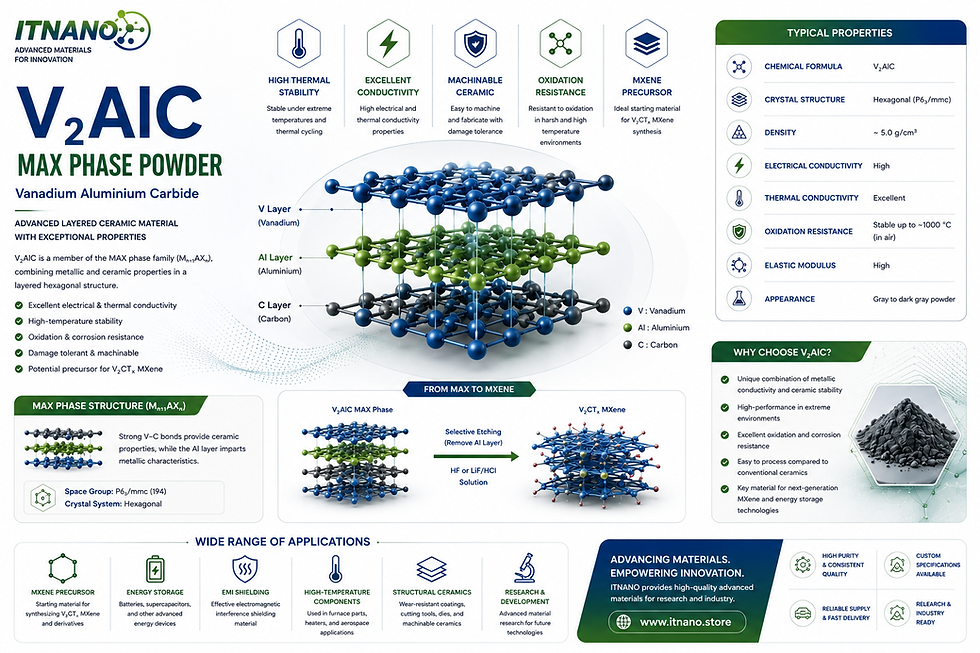
Vanadium MXene produced by etching V₂AlC has been shown to reach a gravimetric capacitance of 181.1 F/g and a volumetric capacitance of 317.8 F/cm³ as a supercapacitor electrode, retaining 89.1% of its capacitance after 5,000 charge-discharge cycles. That performance is a big reason vanadium-based MXene is getting more attention as an alternative to the more commonly used titanium MXene. Vanadium Aluminum Carbide (V₂AlC) is the raw material behind that performance, a layered MAX phase built from vanadium carbide layers interleaved with a single atomic layer of aluminum, carrying the combined metallic and ceramic properties typical of its family. That combination of high electrical conductivity, thermal stability, and layered structure is exactly why V₂AlC is so widely used as a precursor for V₂CTₓ MXene, a battery electrode material, and an EMI shielding filler.
Research labs in Indonesia have typically had to import vanadium-based MAX powder to get high purity. That purity, at this precursor stage, is what determines the quality of the V₂CTₓ MXene produced later, once the etching step is carried out. That's starting to change.
ITNANO (CV. Inovasi Teknologi Nano), based at the NRE Lab in Medan, is Indonesia's first private nanomaterials research startup manufacturing V₂AlC MAX Phase Powder locally, at above 99% purity. Here's what V₂AlC actually is, why its purity matters, and where it's being used in research and industry today.
What Is V₂AlC MAX Phase Powder?
V₂AlC belongs to the MAX phase family, with the general formula Mₙ₊₁AXₙ, where n = 1 in this case. M is a transition metal, vanadium. A is a main-group element, aluminum. X is carbon. Structurally, it's built from layers of vanadium carbide interleaved with a single atomic layer of aluminum, a layered arrangement that gives it the electrical conductivity and thermal stability of a metal, alongside the stiffness and pressure resistance of a ceramic.
Phase purity and elemental composition are the biggest factors in V₂AlC's performance, largely because it's most commonly used as the raw material for synthesizing V₂CTₓ MXene. During etching, the aluminum layer dissolves and the material's volume shrinks, so any impurity already present in the powder becomes more concentrated rather than disappearing. ITNANO's V₂AlC is supplied at above 99% purity, with an elemental composition of 72.2% vanadium, 19.1% aluminum, and 8.4% carbon, impurities kept under 0.3%, and a particle size of 5–10 micrometers (400 mesh). These specifications keep the etching outcome consistent from batch to batch.
Where V₂AlC MAX Phase Powder Is Being Used
Raw material for V₂CTₓ MXene synthesis
V₂AlC's most prominent application is as the starting material for producing V₂CTₓ MXene through selective etching that dissolves the aluminum layer. One study testing V₂CTₓ MXene as a supercapacitor electrode in a simulated seawater electrolyte recorded a capacitance of 181.1 F/g with 89.1% retention after 5,000 cycles, while another study combining V₂CTₓ with a carbon matrix reported a specific capacitance as high as 551 F/g. Performance like that can only be reached when the MAX powder being etched is genuinely free of secondary phases to begin with.
Lithium, sodium, and zinc battery electrodes
V₂AlC's high electrical conductivity makes it relevant to lithium, sodium, and zinc-ion battery applications, either as a conductive additive or as the base material before conversion into MXene. Vanadium is also known for its multiple accessible oxidation states, a property that supports electron-transfer reactions relevant to energy storage performance.
EMI shielding and composite materials
V₂AlC's layered structure and high conductivity make it a subject of research as an EMI shielding filler in polymer composites, absorbing and reflecting electromagnetic interference in electronic devices. The same properties are also relevant to formulating other functional composite materials.
Gas sensors, catalysis, and adsorption
Beyond its role as a precursor, V₂AlC and its derivatives are also being researched for gas sensing and catalytic applications, drawing on their conductivity and surface reactivity. Its layered structure also gives it an affinity for heavy metal ions and azo dye molecules, making it a material of interest for adsorption research and wastewater treatment.
Why Source V₂AlC Locally
Because impurities in MAX powder carry through and become concentrated after etching, precursor purity isn't just a number on a spec sheet. It directly determines the performance of the V₂CTₓ MXene or other downstream material produced from that batch. An imported batch contaminated during production or packaging can't be purified again once it arrives. ITNANO, established by the Titian Research Group's NRE Lab, manufactures V₂AlC domestically with purity control above 99% on every batch, giving Indonesian labs and manufacturers a clean starting point for their vanadium MXene research.
Whether you're synthesizing V₂CTₓ MXene yourself, developing battery or supercapacitor electrodes, formulating EMI shielding composites, or researching gas sensors and adsorption, V₂AlC gives you a precursor purity that a distant supplier can't guarantee after shipping, without the import wait.
See ITNANO's 2D Materials product line for current specifications and pricing.
Get Research-Grade V₂AlC MAX Phase Powder Today
Whether you're working on vanadium MXene synthesis, battery and supercapacitor electrodes, EMI shielding composites, or gas sensor and adsorption research, ITNANO gives you direct access to locally manufactured, research-grade Vanadium Aluminum Carbide (V₂AlC) MAX Phase Powder.
Order this product directly on Tokopedia ITNANO
WhatsApp: +62 822-9800-0698
Also available on Shopee and TikTok Shop
ITNANO is a product line by NRE Lab (CV. Inovasi Teknologi Nano), based in Medan, North Sumatra, Indonesia, advancing local access to graphene, 2D materials, metal-organic frameworks (MOFs), and other advanced nanomaterials for research and industry.


Comments