_edited.jpg)


GO Paste: Print-Ready, High-Viscosity Graphene Oxide, Now Manufactured in Indonesia
- ITNANO Sales
- Jul 23
- 3 min read

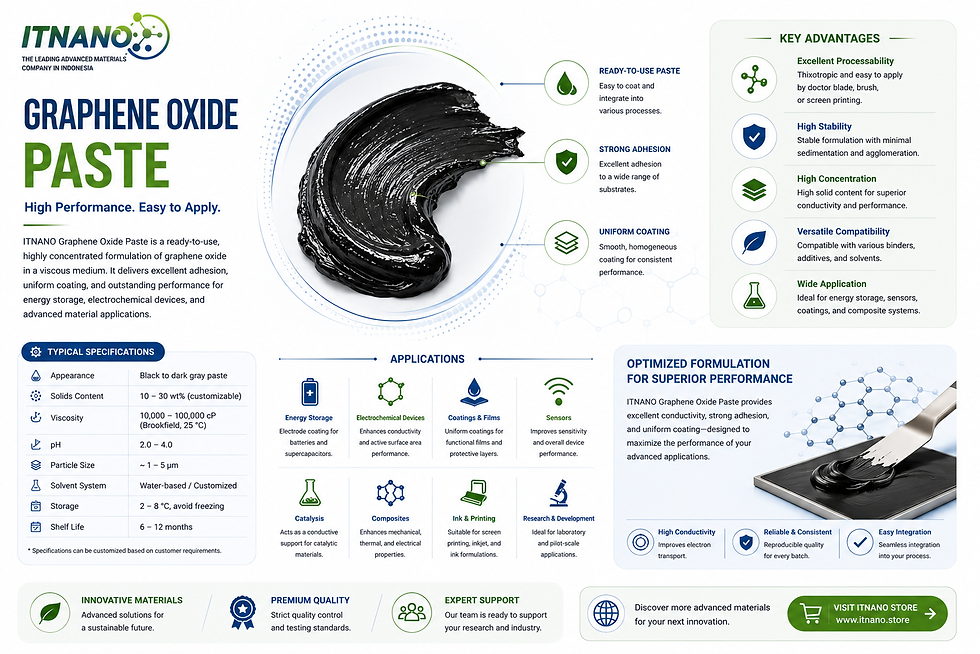
A thin GO dispersion is great for thin coatings or membranes, but the moment an application needs a thick layer that holds its shape screen printing, doctor-blade coating, extrusion, direct ink writing a runny solution becomes the problem: it drips, spreads past the pattern, or lays down too thin a film per pass. GO Paste is built for exactly that case: Graphene Oxide at high solids content with a shear-thinning, viscous-but-flowable rheology, formulated to be printed, extruded, or coated thick without losing its shape the moment printing pressure is released.
A GO paste with reliably consistent rheology has traditionally meant importing a specialty product into Indonesia and rheology is one of the properties most likely to shift over a long shipping transit. That's changing.
ITNANO (CV. Inovasi Teknologi Nano), based at the NRE Lab in Medan, is Indonesia's first private nanomaterials research startup manufacturing research-grade Graphene Oxide locally, including in print-ready paste form. Here's what GO Paste actually is, why its rheology matters, and where it's being used in current research and industry.
What Is GO Paste?
Where GO Dispersion is formulated for low concentration and the lowest viscosity practical so it can be poured, sprayed, or vacuum-filtered into a membrane — GO Paste goes the other direction: its GO content is concentrated much higher, with rheology engineered to be shear-thinning. That means it's thick and holds its shape at rest, but flows smoothly the moment it's put under shear from an extrusion nozzle, a screen, or a doctor blade.
That property isn't just about thickness it's about shape control. A paste that's too thin spreads out and loses pattern resolution the moment it's printed; one that's too thick or doesn't shear-thin clogs the nozzle or the screen. GO Paste is formulated to sit at that sweet spot, keeping graphene oxide sheets evenly dispersed within a viscous matrix without forming clumps that would clog fine printing tools or blur pattern resolution on the substrate.
Because of its high solids content, a single application of GO Paste can also lay down a substantially thicker layer than one pass of a thin dispersion something that matters when the end application calls for a specific film thickness, such as thick electrodes or layered 3D-printed structures.
Where GO Paste Is Being Used
Screen printing and thick-film printed electronics
For printed electrodes, sensors, and circuits that need a thicker, more conductive layer than a single pass of thin ink can deliver, GO Paste offers precise pattern control through screen printing along with enough film thickness in a single printing pass, ahead of the reduction step that activates the layer's conductivity as rGO.
Direct ink writing and graphene-based 3D printing
GO Paste's shear-thinning behavior thick at rest, flowing under extrusion fits directly into the requirements of direct ink writing (DIW) for printing graphene aerogels, porous scaffolds, and layered 3D architectures that need to hold their shape the instant
they leave the nozzle, before being dried or reduced into their final structure.
Doctor-blade electrode coating
In lab-scale battery and supercapacitor electrode fabrication, GO Paste can be applied directly onto a current collector with a doctor blade to form a uniform, controlled-thickness active layer a workflow much closer to industrial slurry-coating than diluting a thin dispersion until it reaches an equivalent viscosity.
Textile printing and conductive fabrics
For smart textiles and conductive garments, a paste that doesn't bleed past its pattern is essential for keeping conductive traces precise on fabric. GO Paste allows conductive patterns to be printed directly onto textile fibers using standard screen-printing techniques, then reduced in situ to rGO to activate conductivity without compromising the fabric's flexibility.
Why Source GO Paste Locally
Rheology is a fragile property temperature swings in transit, long storage times, or physical jostling during shipping can all shift a paste's shear-thinning behavior before it's even used, forcing users to re-calibrate printing parameters they'd already dialed in. ITNANO, established by the Titian Research Group's NRE Lab, produces GO Paste domestically alongside its GO, rGO, and GO Dispersion lines, giving Indonesian manufacturers and labs a paste with fresher, more consistent rheology on arrival.
Whether you're printing thick-film electrodes, building 3D structures with direct ink writing, coating electrodes with a doctor blade, or printing conductive patterns onto textiles, GO Paste gives you shape and thickness control that a thin dispersion simply can't without the import wait.
(See ITNANO's Graphene product line for current specifications and pricing.)
Get Research-Grade GO Paste Today
Whether you're working on screen printing, direct ink writing, electrode coating, or conductive textile printing, ITNANO gives you direct access to locally manufactured, research-grade GO Paste.
Browse graphene specs at itnano.store/graphene
WhatsApp: +62 822-9800-0698
Also available on Tokopedia, Shopee, and TikTok Shop
ITNANO is a product line by NRE Lab (CV. Inovasi Teknologi Nano), based in Medan, North Sumatra, Indonesia. advancing local access to graphene, 2D materials, metal-organic frameworks (MOFs), and other advanced nanomaterials for research and industry.


Comments